Years ago, a few of us area mystery writers had fun reading our work at a Noir at the Bar, our local contribution to a nationwide series of short public readings at popular watering holes in local taverns. Later, I attended another one up in Maine, also a good time.
In this time of Plague, it's now a virtual event. You log on to see authors read their works remotely, with your own choice of beverage. Everyone stays safe, but we get a good night of excellent reads by top authors.
So our recent one was outstanding, hosted by authors Edwin Hill and Daniel Ford.
with readings from authors such as: Edith Maxwell, Paula Munier, Dale T. Phillips, Barbara Ross, Bonnar Spring, Phil Temples, and John Vercher.
If you missed it, you can still give a listen on the excellent writer site Writer's Bone:
http://www.writersbone.com/boston-noir-at-the-bar
There will be others upcoming!
Showing posts with label Reading. Show all posts
Showing posts with label Reading. Show all posts
Wednesday, May 20, 2020


Tuesday, March 31, 2020
My New Book!
Good news for a change. To give everyone something to read, I've got a new book out.
Neptune City- A Mystery. Can you tell by the cover?

When LA detective Jim Lloyd reluctantly returns to his NJ hometown for a final funeral, he is pulled into his troubled past, and a world of secrets, deceit, and danger.
Out in all ebook formats, at Amazon, and Smashwords.
Print coming soon.
Hope you like it.
Neptune City- A Mystery. Can you tell by the cover?

When LA detective Jim Lloyd reluctantly returns to his NJ hometown for a final funeral, he is pulled into his troubled past, and a world of secrets, deceit, and danger.
Out in all ebook formats, at Amazon, and Smashwords.
Print coming soon.
Hope you like it.
Tuesday, September 17, 2019
John Radosta and Bob Dylan
Today we're talking with John Radosta, co-author of Bob Dylan in Performance: Song, Stage and Screen, a lovely new book that describes what the title says.
(use the code LEX30AUTH19 for a 30% discount!)


Q. So how did this book come to be? Please tell us a bit about the origin. What attracted you to this coffee-table book project?
A. It was both thirty years in the making, and very sudden. When I was a student at Boston University, my obsession with Dylan was contagious, and my new roommate Keith, who had barely heard of him before, caught the bug. He went on to become an academic in California and published several articles on Dylan, one of which he presented at a conference here.
I met him for dinner that night, and he told me he’d been offered the chance to write a book, which he’d accepted. Except, he said, he’d never written anything that long, and so he asked me to join him. I told him my crime novels were entirely different from academic writing, but he said a book is a book, and we high-fived over it. Two years to the week later, the book was out.
Q. What's it like to collaborate on a project like this? How did the work flow?
A. So often I’ve read about collaborators having strict routines, and we often see the image of one person at a keyboard with the other hovering and pacing barking out words. For us, on opposite coasts, it was much more like swapping riffs on ideas we each wanted to pursue, suggesting songs or references the other was unfamiliar with. Keith approached the work from a performative point of view, which is his area of study. Meanwhile, as an English teacher, I was interested in the literary allusions and history, so we brought complementary skills to the project.
One thing we never seemed to have trouble with was voice. I think, because we both studied at BU, and with many of the same professors, especially Christopher Ricks, we already had very similar voices, so our final versions sounded the same. Many times I read I line and couldn’t remember who had said it.
Q. Any other books like this you'd recommend?
A. There are so many unbelievably good books about Dylan, but my two favorites are Dylan’s Visions of Sin, by Christopher Ricks (you can read as much bias into that choice as you want!), and Invisible Republic by Greil Marcus. The first one looks at Dylan’s lyrics through a very specific lens, and yet enlarges his impact to encompass a host of interpretations. Marcus’s book also starts with a narrow view—looking at the songs Dylan and the Band recorded in Woodstock, NY that later became The Basement Tapes—and uses it to explore “that weird old America” of rural traditions and ancient ballads that is being erased from our consciousness. Both are fascinating, and highly readable.
Q. Do you remember the first time you recognized a Dylan song?
A. This is a story I tell in the book. I was a teen listening to techno-pop like the Thompson Twins and Duran Duran. When the video for “We Are the World” played on MTV, I asked my dad who that scruffy old guy with the screechy voice was. He pulled out his mono copy of Highway 61, Revisited, and before the end of side one, I was hooked.
Q. What do you feel is his main contribution? Why do you feel his songs are important, and what would you want a reader to take away from reading this book?
A. There’s a song on Tempest, his last (I hope it’s not his last) album of originals, called “Tin Angel.” It’s a murder ballad that shares a set-up with the folk tune “Blackjack Davey,” in which a man comes home to find his wife has run-off with another man, and he rides out to find her. But it turns violent, and all three are dead in the end. Along the way, Dylan mixes in imagery and allusions to the wild west, ancient Greece, and James M. Cain. The mixture highlights the absolute timelessness of the experience, and, through digital downloads, carries it across 3000 years in six minutes. Last time I saw him, his drummer did the solo from “Wipeout!” in the middle of a song from his his recent Modern Times album, and it was like getting the whole history of rock and roll in one tune.
I think Dylan’s extraordinary gift to us is that if we take the time to listen to him, he teaches us how to listen to ourselves, how to use art to filter out the bad and learn what is worth keeping. He renews himself each time he sets out to perform, and by taking part in it, we can, too.
What we would love to have readers take away from this book is that Dylan is not just some hoary old joke of a folkie, but the personification of the jester Don McLean named him, the sole commentator who has the king’s permission to tell us the truth no one else is willing to tell us, and entertain us at the same time. That’s no mean feat.
Q. What makes a good and/or lasting and/or meaningful song?
A. There are lots of great songs that come and go, songs that were perfect for that moment, but when the moment passed, so did the tune. And there are plenty of lousy songs that just worm through your ear. So much depends on who you are when you hear a song, and if you’re ready for its message, whether that message is a call for social justice, or just to get up and dance. But what I’ve noticed in studying Dylan is that the songs that stand the test of time, whether they’re his folk anthems or they’re covers of Sinatra tunes, are the ones that speak to a universal need like love, or and show craftsmanship. Sure, he could write “I and I in a quarter hour, but honestly, almost no one knows that song anymore. But “Blowin’ in the Wind” speaks to the hope we need today, and “The Night We Called it a Day” (check out the video - classic film noir!) became a standard because the wordplay isn’t just clever, it touches on the complicated emotions we’ve all experienced, and gives us not just hope but a map to find our way out.
Q. Have you checked any of Dylan's influences (can be writers, or even artists, musicians, or others) and what is it about their work that attracts you?
A. Dylan led me directly to Woody Guthrie, both his songs and his mind-bending prose, and then to the huge, bizarre, Anthology of American Folk Music collected by Harry Smith. They opened a door to another place and time that otherwise I never would have been able to visit, and their “hard-lipped” songs, as Dylan calls them, present a kaleidoscope of imagery, wry humor, terror and mindfulness you’d never think existed right next to you. Dylan’s also a scholar of the most obscure blues musicians, and that’s a whole other journey I’m looking forward to taking.
Q. What does Dylan say about his songwriting process?
A. He doesn’t like to say much, beyond some cryptic references to a “mathematical” progression to his songs, and his explanation that he got into songwriting because the songs he needed to sing hadn’t been written already. If they had, he said, he’d never have become a writer.
There’s a great story about Dylan and Leonard Cohen talking about writing in the early 1980s. Cohen confessed that it had taken him years to write “Hallelujah.” He asked Dylan how long it had taken to write “I and I,” one of the few good songs of that period, and one of Cohen’s favorite Dylan tunes. The answer was “about 15 minutes.”
Q. Is storytelling mostly entertainment, or does it serve other functions? Does he have particular goals other than telling a good story?
A. My favorite chapter, the one that I knew at the outset I wanted to have in the book, is about Dylan’s connection to the rhapsode or bard, the ancient practitioners of the oral tradition who kept a society’s history, beliefs, and culture in poetic form. These storytellers transmitted the wisdom of the past to the new generations, and at the same time could weave a whole new tale from the formulaic verses of old songs in the service to new events. All those texts, from the Bible to epic poems like The Odyssey and Beowulf, to the massively long ballads of the fifteenth century present their teaching through story.
Dylan does the same thing, often echoing the very words and tunes of the ancients to refract to our ears those old nuggets in ways that allow us to hear, remember, and act upon them. He never accepted that he was “the voice of a generation,” but I firmly believe he is the voice of our culture, and that it was this super-historical quality to his words, music and delivery that earned him the Nobel Prize.
Q. We know he changes the lyrics radically in performance. Like to comment on this
A. One of the keenest pleasures of seeing Dylan in performance (48 times and counting!) is that you are always likely to hear at least one wholly re-imaged version of a song. People who want to
see what they imagine him to have been like 50 or 60 years ago don’t want anything different from what he originally recorded, but his artistic process means he has to always be changing, chasing his muse. Over the years, I’ve heard “Tangled Up in Blue” in about ten completely divergent ways. He’s changed the point of view, the music, even the story, and yet, it is still undeniably the same song. That intrigues me: how far can you stretch a song and have it remain true to itself?
Q. Some might say he did his best back in the sixties, and hasn't had much of note since. Comment? Was Rolling Thunder Revue the high point?
A. In the sixties, while I was busy being born, Dylan was busy redefining what rock music could do. Once he left his mark on folk by making it cool to write new songs, he moved on to the complicated imagery that defines Highway 61 and Blonde on Blonde—great stuff. Then he took the Band on a raucous tour of the UK, basically inventing what would become the modern stadium rock show. But after a sharp turn and as slow trip through Americana, he produced what many think is his best album Blood on the Tracks.
And though it was controversial among his fans (what point in his career wasn’t?) some of his best music came during the late ’70s during his evangelical period. Ok, so the ’80s produced one, maybe
two great songs on some worse-than-mediocre albums, but then as the world was quaking with the arrival of Y2K, he put out a series of albums, from 1997’s Time Out of Mind to 2012’s Tempest that showcase his artistic, historical, musical range. And that’s not even counting the American Songbook albums. For those on this site who are more interested in crime fiction, go listen to Tempest.
It’s an aural noir, full of fire, brimstone, and murder ballads. As for the Rolling Thunder Revue, alas, I was too young for that, too. But the new boxed set does reveal an utterly astounding energy I’ve rarely heard at a Dylan show, though my first, in 1986 with Tom Petty, still ranks as one of the best shows I’ve ever seen.
Q. Did things change in performance after the accident?
A. Ah, the accident. The reason why Dylan and the Band were in Woodstock in ’69. Most definitely things had changed. After two grueling years in which he produced the trio of albums that made his name as a rock icon in the 1960s—Bringing it All Back Home, Highway 61, Revisited, and Blonde on Blonde—after he toured England twice, including the “gone electric” tour that led to the cries of “Judas!” after his secret marriage not to Joan Baez but Sara Lowndes, he had some sort of crash that has never been fully explained. He left the stage for 8 years, but produced these beautiful, introspective, mainly acoustic albums that ushered in the the 1970s “singer-songwriter mellow rock. Songs like “The Man in Me” that you know from The Big Lebowski, and “Lay, Lady, Lay.”
It was the musical style that would define AM radio at the time, and once again, it was Dylan pioneering the trail.
Q. Opinion- who's his best team-up person in performance?
What are his favorite covers of his songs from other performers?
A. I think there’s no contest about a team up person: Dylan and Joan Baez were most definitely the King and Queen. I’d give just about anything to see them together in person. Despite all the off-stage drama, as Baez says in Scorsese’s new film about Rolling Thunder, when they’re on stage together, everything is forgiven.
As for his favorite cover, I can say only this: one of the best songs he put out in his post-accident period was the haunting acoustic “All Along the Watchtower.” After Jimi Hendrix recorded it, Dylan never performed it acoustic again. It’s one of his most-performed tunes, and these days he’s basically covering the cover of his own song.
Q. Tell us a fun fact from the book.
A. I got my first photo credit for the cover. The lack of focus is a deliberate artistic choice. Really.
Q. Any other information you'd like to impart?
A. Just that we truly believe that Dylan’s worth listening to not in spite of his voice, but because of it. He once said, “I can sing as good as Caruso,” and of course it came off as a joke, but he really uses it deliberately, and if you listen, you’ll hear him bending words and phrases so they release meanings you would never get from just reading the lyrics or by hearing Adele or Peter, Paul and Mary crooning them.
I’d also like to say that it is extraordinarily generous of you to give other authors this space to talk about their work, and on behalf of Keith and myself, I want to say thank you for your support. Cheers!
---
Web page: Facebook page “Bob Dylan in Performance: Song, Stage, and Screen”
Where to buy: (use the code LEX30AUTH19 for a
30% discount!)
Bio:
John Radosta, a novelist and author of many short stories, teaches English and creative writing at Milton High School. A long time Dylan observer and veteran of nearly 50 Bob Dylan concerts, he is the co-author of the recently released Bob Dylan in Performance: Song, Stage and Screen, an in depth look at Dylan the performer and the link of his performances to the historical bardic role, to American popular song tradition, and to rock music culture.
(use the code LEX30AUTH19 for a 30% discount!)


Q. So how did this book come to be? Please tell us a bit about the origin. What attracted you to this coffee-table book project?
A. It was both thirty years in the making, and very sudden. When I was a student at Boston University, my obsession with Dylan was contagious, and my new roommate Keith, who had barely heard of him before, caught the bug. He went on to become an academic in California and published several articles on Dylan, one of which he presented at a conference here.
I met him for dinner that night, and he told me he’d been offered the chance to write a book, which he’d accepted. Except, he said, he’d never written anything that long, and so he asked me to join him. I told him my crime novels were entirely different from academic writing, but he said a book is a book, and we high-fived over it. Two years to the week later, the book was out.
Q. What's it like to collaborate on a project like this? How did the work flow?
A. So often I’ve read about collaborators having strict routines, and we often see the image of one person at a keyboard with the other hovering and pacing barking out words. For us, on opposite coasts, it was much more like swapping riffs on ideas we each wanted to pursue, suggesting songs or references the other was unfamiliar with. Keith approached the work from a performative point of view, which is his area of study. Meanwhile, as an English teacher, I was interested in the literary allusions and history, so we brought complementary skills to the project.
One thing we never seemed to have trouble with was voice. I think, because we both studied at BU, and with many of the same professors, especially Christopher Ricks, we already had very similar voices, so our final versions sounded the same. Many times I read I line and couldn’t remember who had said it.
Q. Any other books like this you'd recommend?
A. There are so many unbelievably good books about Dylan, but my two favorites are Dylan’s Visions of Sin, by Christopher Ricks (you can read as much bias into that choice as you want!), and Invisible Republic by Greil Marcus. The first one looks at Dylan’s lyrics through a very specific lens, and yet enlarges his impact to encompass a host of interpretations. Marcus’s book also starts with a narrow view—looking at the songs Dylan and the Band recorded in Woodstock, NY that later became The Basement Tapes—and uses it to explore “that weird old America” of rural traditions and ancient ballads that is being erased from our consciousness. Both are fascinating, and highly readable.
Q. Do you remember the first time you recognized a Dylan song?
A. This is a story I tell in the book. I was a teen listening to techno-pop like the Thompson Twins and Duran Duran. When the video for “We Are the World” played on MTV, I asked my dad who that scruffy old guy with the screechy voice was. He pulled out his mono copy of Highway 61, Revisited, and before the end of side one, I was hooked.
Q. What do you feel is his main contribution? Why do you feel his songs are important, and what would you want a reader to take away from reading this book?
A. There’s a song on Tempest, his last (I hope it’s not his last) album of originals, called “Tin Angel.” It’s a murder ballad that shares a set-up with the folk tune “Blackjack Davey,” in which a man comes home to find his wife has run-off with another man, and he rides out to find her. But it turns violent, and all three are dead in the end. Along the way, Dylan mixes in imagery and allusions to the wild west, ancient Greece, and James M. Cain. The mixture highlights the absolute timelessness of the experience, and, through digital downloads, carries it across 3000 years in six minutes. Last time I saw him, his drummer did the solo from “Wipeout!” in the middle of a song from his his recent Modern Times album, and it was like getting the whole history of rock and roll in one tune.
I think Dylan’s extraordinary gift to us is that if we take the time to listen to him, he teaches us how to listen to ourselves, how to use art to filter out the bad and learn what is worth keeping. He renews himself each time he sets out to perform, and by taking part in it, we can, too.
What we would love to have readers take away from this book is that Dylan is not just some hoary old joke of a folkie, but the personification of the jester Don McLean named him, the sole commentator who has the king’s permission to tell us the truth no one else is willing to tell us, and entertain us at the same time. That’s no mean feat.
Q. What makes a good and/or lasting and/or meaningful song?
A. There are lots of great songs that come and go, songs that were perfect for that moment, but when the moment passed, so did the tune. And there are plenty of lousy songs that just worm through your ear. So much depends on who you are when you hear a song, and if you’re ready for its message, whether that message is a call for social justice, or just to get up and dance. But what I’ve noticed in studying Dylan is that the songs that stand the test of time, whether they’re his folk anthems or they’re covers of Sinatra tunes, are the ones that speak to a universal need like love, or and show craftsmanship. Sure, he could write “I and I in a quarter hour, but honestly, almost no one knows that song anymore. But “Blowin’ in the Wind” speaks to the hope we need today, and “The Night We Called it a Day” (check out the video - classic film noir!) became a standard because the wordplay isn’t just clever, it touches on the complicated emotions we’ve all experienced, and gives us not just hope but a map to find our way out.
Q. Have you checked any of Dylan's influences (can be writers, or even artists, musicians, or others) and what is it about their work that attracts you?
A. Dylan led me directly to Woody Guthrie, both his songs and his mind-bending prose, and then to the huge, bizarre, Anthology of American Folk Music collected by Harry Smith. They opened a door to another place and time that otherwise I never would have been able to visit, and their “hard-lipped” songs, as Dylan calls them, present a kaleidoscope of imagery, wry humor, terror and mindfulness you’d never think existed right next to you. Dylan’s also a scholar of the most obscure blues musicians, and that’s a whole other journey I’m looking forward to taking.
Q. What does Dylan say about his songwriting process?
A. He doesn’t like to say much, beyond some cryptic references to a “mathematical” progression to his songs, and his explanation that he got into songwriting because the songs he needed to sing hadn’t been written already. If they had, he said, he’d never have become a writer.
There’s a great story about Dylan and Leonard Cohen talking about writing in the early 1980s. Cohen confessed that it had taken him years to write “Hallelujah.” He asked Dylan how long it had taken to write “I and I,” one of the few good songs of that period, and one of Cohen’s favorite Dylan tunes. The answer was “about 15 minutes.”
Q. Is storytelling mostly entertainment, or does it serve other functions? Does he have particular goals other than telling a good story?
A. My favorite chapter, the one that I knew at the outset I wanted to have in the book, is about Dylan’s connection to the rhapsode or bard, the ancient practitioners of the oral tradition who kept a society’s history, beliefs, and culture in poetic form. These storytellers transmitted the wisdom of the past to the new generations, and at the same time could weave a whole new tale from the formulaic verses of old songs in the service to new events. All those texts, from the Bible to epic poems like The Odyssey and Beowulf, to the massively long ballads of the fifteenth century present their teaching through story.
Dylan does the same thing, often echoing the very words and tunes of the ancients to refract to our ears those old nuggets in ways that allow us to hear, remember, and act upon them. He never accepted that he was “the voice of a generation,” but I firmly believe he is the voice of our culture, and that it was this super-historical quality to his words, music and delivery that earned him the Nobel Prize.
Q. We know he changes the lyrics radically in performance. Like to comment on this
A. One of the keenest pleasures of seeing Dylan in performance (48 times and counting!) is that you are always likely to hear at least one wholly re-imaged version of a song. People who want to
see what they imagine him to have been like 50 or 60 years ago don’t want anything different from what he originally recorded, but his artistic process means he has to always be changing, chasing his muse. Over the years, I’ve heard “Tangled Up in Blue” in about ten completely divergent ways. He’s changed the point of view, the music, even the story, and yet, it is still undeniably the same song. That intrigues me: how far can you stretch a song and have it remain true to itself?
Q. Some might say he did his best back in the sixties, and hasn't had much of note since. Comment? Was Rolling Thunder Revue the high point?
A. In the sixties, while I was busy being born, Dylan was busy redefining what rock music could do. Once he left his mark on folk by making it cool to write new songs, he moved on to the complicated imagery that defines Highway 61 and Blonde on Blonde—great stuff. Then he took the Band on a raucous tour of the UK, basically inventing what would become the modern stadium rock show. But after a sharp turn and as slow trip through Americana, he produced what many think is his best album Blood on the Tracks.
And though it was controversial among his fans (what point in his career wasn’t?) some of his best music came during the late ’70s during his evangelical period. Ok, so the ’80s produced one, maybe
two great songs on some worse-than-mediocre albums, but then as the world was quaking with the arrival of Y2K, he put out a series of albums, from 1997’s Time Out of Mind to 2012’s Tempest that showcase his artistic, historical, musical range. And that’s not even counting the American Songbook albums. For those on this site who are more interested in crime fiction, go listen to Tempest.
It’s an aural noir, full of fire, brimstone, and murder ballads. As for the Rolling Thunder Revue, alas, I was too young for that, too. But the new boxed set does reveal an utterly astounding energy I’ve rarely heard at a Dylan show, though my first, in 1986 with Tom Petty, still ranks as one of the best shows I’ve ever seen.
Q. Did things change in performance after the accident?
A. Ah, the accident. The reason why Dylan and the Band were in Woodstock in ’69. Most definitely things had changed. After two grueling years in which he produced the trio of albums that made his name as a rock icon in the 1960s—Bringing it All Back Home, Highway 61, Revisited, and Blonde on Blonde—after he toured England twice, including the “gone electric” tour that led to the cries of “Judas!” after his secret marriage not to Joan Baez but Sara Lowndes, he had some sort of crash that has never been fully explained. He left the stage for 8 years, but produced these beautiful, introspective, mainly acoustic albums that ushered in the the 1970s “singer-songwriter mellow rock. Songs like “The Man in Me” that you know from The Big Lebowski, and “Lay, Lady, Lay.”
It was the musical style that would define AM radio at the time, and once again, it was Dylan pioneering the trail.
Q. Opinion- who's his best team-up person in performance?
What are his favorite covers of his songs from other performers?
A. I think there’s no contest about a team up person: Dylan and Joan Baez were most definitely the King and Queen. I’d give just about anything to see them together in person. Despite all the off-stage drama, as Baez says in Scorsese’s new film about Rolling Thunder, when they’re on stage together, everything is forgiven.
As for his favorite cover, I can say only this: one of the best songs he put out in his post-accident period was the haunting acoustic “All Along the Watchtower.” After Jimi Hendrix recorded it, Dylan never performed it acoustic again. It’s one of his most-performed tunes, and these days he’s basically covering the cover of his own song.
Q. Tell us a fun fact from the book.
A. I got my first photo credit for the cover. The lack of focus is a deliberate artistic choice. Really.
Q. Any other information you'd like to impart?
A. Just that we truly believe that Dylan’s worth listening to not in spite of his voice, but because of it. He once said, “I can sing as good as Caruso,” and of course it came off as a joke, but he really uses it deliberately, and if you listen, you’ll hear him bending words and phrases so they release meanings you would never get from just reading the lyrics or by hearing Adele or Peter, Paul and Mary crooning them.
I’d also like to say that it is extraordinarily generous of you to give other authors this space to talk about their work, and on behalf of Keith and myself, I want to say thank you for your support. Cheers!
---
Web page: Facebook page “Bob Dylan in Performance: Song, Stage, and Screen”
Where to buy: (use the code LEX30AUTH19 for a
30% discount!)
Bio:
John Radosta, a novelist and author of many short stories, teaches English and creative writing at Milton High School. A long time Dylan observer and veteran of nearly 50 Bob Dylan concerts, he is the co-author of the recently released Bob Dylan in Performance: Song, Stage and Screen, an in depth look at Dylan the performer and the link of his performances to the historical bardic role, to American popular song tradition, and to rock music culture.
Tuesday, November 20, 2018
Noir at the Bar- Maine Writers
Maine has so many good writers, and this was evident in the recent Noir at the Bar held in Biddeford.


So each writer came up to read a short piece. Gayle Lynds kicks off, with a great true story about how she offered to sign her own books at an airport kiosk, but the unbelieving dipstick register person said she couldn't allow the books to "be defaced" by the author's signature!


Here's the group shot

It was held in a funky and interesting bar

A great crowd gathered to hear the amazing array of talent


So each writer came up to read a short piece. Gayle Lynds kicks off, with a great true story about how she offered to sign her own books at an airport kiosk, but the unbelieving dipstick register person said she couldn't allow the books to "be defaced" by the author's signature!

Brenda Buchanan was the Mistress of Ceremonies

Barb Ross says her piece
To see an interview with Barbara, click here

Bruce Coffin does his thing
To see an interview with Bruce, click here

Dick Cass, another tall galoot, gets up
To see an interview with Dick, click here

Yet more height, as James Hayman takes the stand
To see an interview with James, click here

The authors had their books for sale, and business was brisk

More authors! Maureen Milliken


Each author also contributed a book (as did I, upon request) for a huge basket of reading.
Here Gayle picks the lucky winner

The audience enjoyed the afternoon


As did the authors. Thanks to all for a fun time!


Saturday, November 3, 2018
Local Author Fair at Chelmsford Library
We had a terrific day for our Chelmsford Library annual Local Author Day.
To see who everyone is, click the library link above for their writeup on each author.
Thanks to Jessica, Lisa, and the library staff for this day and for the support they always give to our local author community.


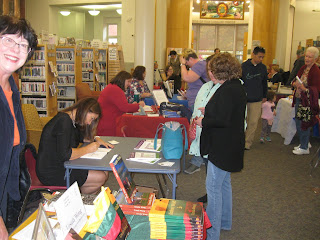


To see who everyone is, click the library link above for their writeup on each author.
Thanks to Jessica, Lisa, and the library staff for this day and for the support they always give to our local author community.

We made local news- a few pics from the event.
Lots of local authors showed up to talk about their work and meet library patrons.
We sold books, which make great holiday gifts!
Ursula Wong shows one of her Amber series (great for WWII buffs)

Sara Marks has a few of her own updated Jane Austen tales to tell you about

And Laura Fedolfi with her revealing mythology-flavored Hannah series

My own display

We each had a chance to take the mic and tell everyone about our work.
Here's Kathleen Murphy for her turn

And Ursula

Quite a good crowd flowing through. Lots of readers in this literate town!


Tuesday, May 9, 2017
Interview With Author Dave Zeltserman- Book to Film
Big treat for you today- we're speaking with Dave Zeltserman, an author who's having a pretty good year.


Q. So how did this novel come to be? Was it envisioned from the start as a bigger canvas, or did it expand organically out of an idea? Please tell us a bit about the origin.
A. The idea was triggered by an article I read about the Denver’s sheriff’s office in the 60s, and how these officers were robbing the stores blind that they were supposed to be protecting. I started playing what-if games with this idea of an utterly corrupt sheriff’s office, and that led to Small Crimes being born.
Q. Did you start with the germ of an idea and start writing to see where it went, or did you map a good deal out in your head (or even outline) before crafting?
A. I need a detailed outline before I start writing. At some point while I’m writing the book will become something organic and take on a life of its own. New characters and subplots will develop, but I’ll always navigate back to my original roadmap.
Q. What do you feel is the main theme(s)?
A. Small Crimes is noir. A man’s past crimes dooming him. There’s the added element that all of his scheming to try to escape responsibility ends up causing so much damage to the town, but at its heart, this is pure noir.
Q. Why do you feel this is important, and what would you want a reader to take away from reading this book?
A. I enjoy well-written noir more than any other type of crime fiction. It explores dark realms of the soul that are barely touched on by other crime and mystery subgenres. It can also be thrilling as the reader puts himself/herself in the place of the noir protagonist desperate for a way out of a doom that there is no escape from.
Q. What makes a good book or engaging story?
A. For the reader to completely disappear into the fictional world. I don’t necessarily need the protagonist to be likeable, but I need him to be fascinating, and I need to be fully engulfed in his problems and desires. There has to be a growing, nearly unbearable tension. I need to want to turn the page to find out what happens next.
Q. Are there writers with similar themes to yours? Who are your influences (can be writers, or even artists, musicians, or others) and what is it about their work that attracts you?
A. Jim Thompson and James M. Cain wrote probably the best noir fiction of the 20th century. When I reread SMALL CRIMES, I also saw in the more hardboiled action sequences strains of Dan Marlowe, who wrote the classic noir/hardboiled crime novel THE NAME OF THE GAME IS DEATH. I love noir. I love the depths it brings you to, and how it challenges you. I love the tension that great noir creates.
Q. Is storytelling mostly entertainment, or does it serve other functions? Do you have particular goals other than telling a good story?
A. Entertainment is an important element, but fiction can also help the reader better understand the human psyche, and take them places they wouldn’t otherwise go. Some of my novels are imbued with themes I wish to explore, some are just meant to be thrilling escapes.
Q. Any other goals you've set for yourself, professionally or personally?
A. I’m trying to write professionally, in other words, make a living at it. SMALL CRIMES being made into a feature film helps. I have several other movies based on my books in development, and if those get made it will help even more.
Q. Some writers write fast and claim not to rewrite much. Do you do this, or painstakingly revise? When you send the book off to the publisher, are you happy with it, or just tired of it?
A. I write a detailed outline before starting. This helps me keep my plot from needing much, if any, revision. I do line editing every hundred pages, which also allows me to get a feel for how the book is working, and then another pass of line editing once I’m done. Publishers will then do two passes of editing—one with the editor, the other with the copyeditor. So far the editor passes have been fairly light—mostly line editing, and none of my books have required significant changes.
Q. Do you have good editors, and if so, how do they help you? Do they look for particular things? Do you have different people for different editing levels?
A. I’ve had 4 books published by Serpent’s Tail with one editor, and the editing was extremely light—maybe a half dozen light edit requests or name changes. With my four Overlook Books, I had four different editors, all at different levels. The Boy Who Killed Demons probably went through the most extensive editing of these. Right now I’m being published by Kensington, with the same editor, and I’m enjoying working with her.
Q. If a writer came to you for advice, how would you help?
A. Do anything but writing if you can help it. Seriously. It’s the most random enterprise you can possibly get into, and there’s so much outside of your control. But if you’re truly driven to write, and it’s all you want to do, and you want to be published, then take it seriously as a business. Read and understand the types of books the industry is looking for. Understand that the industry isn’t looking for great books, but good commercial books. It took me years to learn that last lesson.
Q. Stories can be told by using a different medium, and Small Crimes is now a big movie. How does that alter the story?
A. Changes will always have to be made, both because of budgetary and time constraints, and of course, the director’s vision. There were quite a few changes for the SMALL CRIMES film, but somehow the director/screenwriter made it faithful to the spirit of the book. Even with the changes, I’m happy with it.
Q. What's the next step in your writing world?
A. I’m writing a serious of crime thrillers for Kensington Books. The first of these DERANGED came out in March, the second, CRAZED, will be out in September. Right now I’m writing book 4 in this series. I think these are fun, twisty books, with lots of surprises and twists, some humor, and a bull terrier!
Q. Tell us fun facts about yourself.
A. How about that I had dinner with Robert Forster during the shooting of SMALL CRIMES?
Or that I also have published two computer books?
Or that when I was in my 40s I started studying Kung Fu and earned a black belt?
Website: https://www.davezeltserman.com
Here's a good mug shot for a writer of crime novels.

First, he's adding to his output of books by writing a serious of successful crime thrillers for Kensington Books (note the pen name)

And big news is the recent release of a major film made from his book Small Crimes
(currently a steal on Kindle- grab it!).
(currently a steal on Kindle- grab it!).
Starring Nikolaj Coster-Waldau (Game of Thrones' Jaime Lannister)

Q. So how did this novel come to be? Was it envisioned from the start as a bigger canvas, or did it expand organically out of an idea? Please tell us a bit about the origin.
A. The idea was triggered by an article I read about the Denver’s sheriff’s office in the 60s, and how these officers were robbing the stores blind that they were supposed to be protecting. I started playing what-if games with this idea of an utterly corrupt sheriff’s office, and that led to Small Crimes being born.
Q. Did you start with the germ of an idea and start writing to see where it went, or did you map a good deal out in your head (or even outline) before crafting?
A. I need a detailed outline before I start writing. At some point while I’m writing the book will become something organic and take on a life of its own. New characters and subplots will develop, but I’ll always navigate back to my original roadmap.
Q. What do you feel is the main theme(s)?
A. Small Crimes is noir. A man’s past crimes dooming him. There’s the added element that all of his scheming to try to escape responsibility ends up causing so much damage to the town, but at its heart, this is pure noir.
Q. Why do you feel this is important, and what would you want a reader to take away from reading this book?
A. I enjoy well-written noir more than any other type of crime fiction. It explores dark realms of the soul that are barely touched on by other crime and mystery subgenres. It can also be thrilling as the reader puts himself/herself in the place of the noir protagonist desperate for a way out of a doom that there is no escape from.
Q. What makes a good book or engaging story?
A. For the reader to completely disappear into the fictional world. I don’t necessarily need the protagonist to be likeable, but I need him to be fascinating, and I need to be fully engulfed in his problems and desires. There has to be a growing, nearly unbearable tension. I need to want to turn the page to find out what happens next.
Q. Are there writers with similar themes to yours? Who are your influences (can be writers, or even artists, musicians, or others) and what is it about their work that attracts you?
A. Jim Thompson and James M. Cain wrote probably the best noir fiction of the 20th century. When I reread SMALL CRIMES, I also saw in the more hardboiled action sequences strains of Dan Marlowe, who wrote the classic noir/hardboiled crime novel THE NAME OF THE GAME IS DEATH. I love noir. I love the depths it brings you to, and how it challenges you. I love the tension that great noir creates.
Q. Is storytelling mostly entertainment, or does it serve other functions? Do you have particular goals other than telling a good story?
A. Entertainment is an important element, but fiction can also help the reader better understand the human psyche, and take them places they wouldn’t otherwise go. Some of my novels are imbued with themes I wish to explore, some are just meant to be thrilling escapes.
Q. Any other goals you've set for yourself, professionally or personally?
A. I’m trying to write professionally, in other words, make a living at it. SMALL CRIMES being made into a feature film helps. I have several other movies based on my books in development, and if those get made it will help even more.
Q. Some writers write fast and claim not to rewrite much. Do you do this, or painstakingly revise? When you send the book off to the publisher, are you happy with it, or just tired of it?
A. I write a detailed outline before starting. This helps me keep my plot from needing much, if any, revision. I do line editing every hundred pages, which also allows me to get a feel for how the book is working, and then another pass of line editing once I’m done. Publishers will then do two passes of editing—one with the editor, the other with the copyeditor. So far the editor passes have been fairly light—mostly line editing, and none of my books have required significant changes.
Q. Do you have good editors, and if so, how do they help you? Do they look for particular things? Do you have different people for different editing levels?
A. I’ve had 4 books published by Serpent’s Tail with one editor, and the editing was extremely light—maybe a half dozen light edit requests or name changes. With my four Overlook Books, I had four different editors, all at different levels. The Boy Who Killed Demons probably went through the most extensive editing of these. Right now I’m being published by Kensington, with the same editor, and I’m enjoying working with her.
Q. If a writer came to you for advice, how would you help?
A. Do anything but writing if you can help it. Seriously. It’s the most random enterprise you can possibly get into, and there’s so much outside of your control. But if you’re truly driven to write, and it’s all you want to do, and you want to be published, then take it seriously as a business. Read and understand the types of books the industry is looking for. Understand that the industry isn’t looking for great books, but good commercial books. It took me years to learn that last lesson.
Q. Stories can be told by using a different medium, and Small Crimes is now a big movie. How does that alter the story?
A. Changes will always have to be made, both because of budgetary and time constraints, and of course, the director’s vision. There were quite a few changes for the SMALL CRIMES film, but somehow the director/screenwriter made it faithful to the spirit of the book. Even with the changes, I’m happy with it.
Q. What's the next step in your writing world?
A. I’m writing a serious of crime thrillers for Kensington Books. The first of these DERANGED came out in March, the second, CRAZED, will be out in September. Right now I’m writing book 4 in this series. I think these are fun, twisty books, with lots of surprises and twists, some humor, and a bull terrier!
Q. Tell us fun facts about yourself.
A. How about that I had dinner with Robert Forster during the shooting of SMALL CRIMES?
Or that I also have published two computer books?
Or that when I was in my 40s I started studying Kung Fu and earned a black belt?
Website: https://www.davezeltserman.com
Saturday, April 29, 2017
Writeup of the Author Event at UMass O'Leary Library
We had a fun book signing event at the UMass O'Leary Library in Lowell. Attending were local authors with books to sell to the public.
Many thanks to Sara Marks for setting this up (and cookies and water), and to the library for hosting us. The students were hard at work studying for finals, and they probably couldn't hear us with their ear buds in.


Many thanks to Sara Marks for setting this up (and cookies and water), and to the library for hosting us. The students were hard at work studying for finals, and they probably couldn't hear us with their ear buds in.
Beth Logan, who's written tax guides

Donna Marie Rucinski Harrington and Laura

Kameryn James, with a shining halo!

Laura Marshall, who also runs the Society of Independent Publishers and Authors

My setup. Love the new bookracks!

Paul Marion, poet and more


Sara Marks (Twitter: @sara_marks) and Matthew Jones
They both work on The Mill Pages Magazine, seen here


Subscribe to:
Posts (Atom)